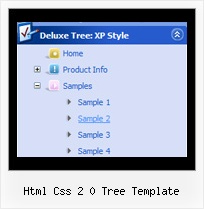
Recent Questions Html Css 2 0 Tree Template
Q: We purchased your software and would like a way to give our users the ability to right click (or equivalent) and open a link in to a new window.
Is there a way to do this? If not, do you have a work around that people have found helpful.
As an example, I have a menu item that goes to http://www.google.com. Typically, it loads this in to one of our frames. However, I would like the end user to have the ability to either load it in to one of our existing frames or to load it in its own window.
A: You can try to write the following code for your items:
["<a href='index.html' target='_blank' class='home'>Home</a>","", "", "", "", "Return to Index page", "", "0", "", ],
And create styles
.home{
color: #FFFFFF;}
.home:hover{
color: #FFBEBE;}
Q: I would like to know if there are problems with your menu dynamique javascript and google PR. and the code that will appear on my pages (if i install your menu dynamique javascript).
I previously have installed open cube menus and my pr has been reduced from 6 to 0 and i am still waiting to have it back.
Will your menu have problems?
A: You should generate search engine friendly code and install it on yourpage.
JavaScript Tree Menu is a search engine friendly menu since v1.12.
To create a search engine friendly menu you should add additional html code within your html page:
<div id="dmlinks">
<a href="http://deluxe-menu.com">menu_item_text1</a>
<a href="http://deluxe-tree.com">menu_item_text2</a>
...etc.
</div>
To generate such a code use Deluxe Tuner application.
Run Tuner, load your menu and click Tools/Generate SE-friendly Code (F3).
We use search engine friendly code on our websites
http://deluxe-menu.com
http://deluxe-tree.com
http://deluxe-tabs.com
and our customers use this code on there sites without any problems.
As you can see Google doesn't penalize them.
Q: I am trying out your menu and I've made out a little test case in the attached file.
If you run it, you will see that the horizontal drop down menu css scrollsOUTSIDE the container div to the edges of the window. Is there anyway I can make the hhorizontal drop down menu css be within the container div and yet scroll?
And will the solution be cross-browser?
Note that menuDiv needs to have a collapsableDiv style. I am assuming that that is not a problem.
A: Try to set exact width for the submenu:
var smWidth="925px";
Q: I'm testing the trial version and I'm having a little problem with the state saving. Everytime it navigates to another page, it does not save the state, even with
var tsaveState=1;
In fact, it actually opens up a different menu other than the one I originally clicked.
A: See, if you open pages (with menus) from different folder it means that you open different menus. So, when you change a state, for example, of the first menu within "newzap/" folder and then open another page with the menu within "newzap/learn/", browsers looks for another cookie file and can't find it and the second menu stays in a default state.
Try to set different
var tsavePrefix="menu1";
var tsavePrefix="menu2";
var tsavePrefix="menu3";
for different menus.
That should work.